
Abstract
Composition, rhetoric, and writing studies (CRWS) as a field has historically recognized the importance of mentoring for graduate students, but there can be a disconnect between learning theory and how mentoring occurs in practice. In this article, we argue for a more systematic approach to graduate student mentoring that recognizes the benefits of horizontal mentoring relationships. We draw on our own experiences, as well as scholarship in mentoring and learning, to demonstrate the crucial role that horizontal mentoring can play in supporting CRWS graduate students holistically. Ultimately, we offer strategies and ideas for faculty members to more effectively support graduate students as they cultivate this network of mentors while enrolled in graduate programs and courses.
Keywords
Graduate student education, mentoring, learning theory, programmatic strategies
Composition, rhetoric, and writing studies (CRWS) as a field takes mentorship of graduate students and junior academics seriously, as evidenced by a wealth of scholarship dedicated to mentoring (including Eble and Gailet; Ballif et al.; Rodrigo et al.), the 2019 CCCC Statement of Professional Guidance for Mentoring Graduate Students, and the number of awards and programs that center on mentoring in organizations like CCCC, FemRhets, WPA, and AWAC.[1] Much of the mentoring scholarship challenges the master-apprentice relationship inherent in traditional views of mentoring and advocates for more feminist models (Bloom; Eble and Gailet; Miles and Burnett; Moss et al.), but the common focus on power dynamics in these relationships leaves out research on how learning works.
We have felt this tension in our personal experiences as well, as we will detail throughout this article as part of our framework and methodology. The learning challenges that we faced in graduate school could not be resolved solely by working with an expert mentor but required support and guidance from someone at a similar spot in their learning experience. This reality—and reflecting on how we personally navigated moments of stuckness together—has spurred our collective interest in graduate student mentoring and the writing of this article. Our stories are an important part of how we have come to understand learning theory as we do, and we weave them throughout our literature review to demonstrate the invisible yet meaningful lived experiences of graduate students.
We began our graduate studies at Miami University (Ohio) in 2016, when Caitlin started her PhD and Mandy her MA. As graduate students, we worked closely together in courses and in graduate writing program administration (gWPA) positions. Through these experiences, we developed what we now recognize as a “horizontal mentoring” relationship (VanHaitsma and Ceraso) that continued into our positions post-PhD—similar to VanHaitsma and Ceraso’s original dynamic on the job market and as early-career academics but distinct in that we were two early-career graduate students. What began as two friends debriefing over Wendy’s Frosties after a grad seminar or working together at the library morphed into a more intentional space where we not only provided emotional support but also feedback and strategies for resolving challenges we faced. Our relationship was, in some ways, a result of the local conditions in which we worked: in shared spaces, with the same faculty, and with similar goals and interests driving us. While this relationship was afforded by our institutional context, it is a more direct result of our ability to identify and use existing structures in novel ways (a point about which we will say more later). In fact, no one else in our cohort established a similar relationship despite having access to similar resources and supportive faculty. Instead, the department culture tended to emphasize mentoring relationships between a faculty member and a graduate student with the occasional encouragement to speak with another graduate student who was further along.
These lived experiences encouraged us to cultivate a practice of horizontal mentoring that was vital to us completing our graduate degrees. In this article, we build from scholarship in both mentoring and learning theories, as well as weaving in our own lived experiences, to advocate for a more intentional, structured approach to graduate mentoring in our field that specifically includes horizontal mentoring. We argue that there is a disconnect between how learning works and the types of mentoring that graduate students experience in practice. Horizontal mentorship is a way to bridge this disconnect. Newcomers to the field, especially graduate students, benefit from multiple mentors of varying levels of expertise, and graduate programs and departments should intentionally cultivate spaces for these relationships to develop. As we will address, sociocultural theories of learning suggest that there may be some moments of development that only graduate students can support each other through. We begin by briefly describing horizontal mentoring and outlining why it is crucial for graduate students based on theories of learning. We illustrate this mentoring relationship with an example from our own experiences that we find a particularly powerful argument for the benefits of horizontal mentoring. Ultimately, we offer strategies and ideas for faculty members to more effectively support graduate students as these students cultivate a network of mentors in their graduate programs and throughout their graduate courses.
What is Horizontal Mentoring?
Horizontal mentoring is the term VanHaitsma and Ceraso use to describe peer mentoring relationships that involve “the offering of help, guidance, and training” (211). These relationships are “horizontal rather than hierarchical” because they involve relative equals rather than “a more and less experienced mentor and mentee” (211). In principle, horizontal mentoring is similar to other approaches like co-mentoring, peer mentoring, “sibling-scholar networks” (Bridges), or lateral mentoring (Eby). These relationships resemble other traditional mentoring relationships in that they often include formalized, regularly occurring meetings, but two (or more) individuals support each other as they work toward shared or similar goals rather than an expert mentor providing advice to a novice mentee (McGuire and Reger; VanHaitsma and Ceraso). For example, VanHaitsma and Ceraso describe how they intentionally mentored each other as they wrote job market materials, five-year plans, and book projects. Their relationship addressed challenges that often, but not always, seem beyond the scope of hierarchical mentoring relationships, such as work-life balance and personal wellbeing. Horizontal mentoring relationships, then, can both fill a gap graduate students experience in traditional mentoring and provide a model for continued mentoring and collaboration beyond graduate studies.
We suspect that many graduate students are already engaging in horizontal mentoring. Perhaps they are like us, and horizontal mentoring provides a concrete term for something they had merely stumbled their ways into. VanHaitsma and Ceraso provided a term for something we had been doing (at the time) for nearly two years. We had supported each other as we took difficult courses and as we dealt with the problematic labor conditions we experienced. As gWPAs, we had helped each other articulate our administrative principles for a graduate seminar, but then we used those same principles to identify how to advocate for change in our administrative experiences. Like others who write about horizontal mentoring, we began by supporting each other through challenges where other, traditional mentors were not a source of the support we needed (McGuire and Reger). Around the same time, Caitlin moved out of course work and into dissertation drafting and Mandy started a special project for the Howe Center for Writing Excellence on how graduate students learn to write. We began working more closely with a new faculty mentor, but we also continued to mentor each other in ways that were likely invisible to her: we helped each other surface and deal with frustrations in our own roles and positionality, such as the time Mandy struggled with the tension between writing a seminar paper and writing an article on the same topic. We also served as early readers (or listeners) of even the most ill-formed seminar paper and dissertation ideas.
In hindsight, it does not seem surprising to us that our horizontal mentoring became explicit to us when we moved into conducting more independent research, given the highly decentralized nature of this stage of graduate learning (Simpson). We noticed a distinct shift in the nature and availability of mentorship as we left course work and the built-in sense of community that regularly meeting with groups of people can bring. Once we realized that we were engaged in horizontal mentoring, we became more intentional in setting up times for working together that provided a space for this mentoring outside our regular time together as friends and coworkers. Yet these activities were still mostly invisible to, and thus rarely supported in a meaningful way, by the faculty members around us. Other graduate students commented on these same feelings of isolation, but also seemed to believe it was a natural part of the process of earning a PhD.
Existing scholarship offers strategies for groups who want to develop their own horizontal mentoring practice (McGuire and Reger; VanHaitsma and Ceraso) or approaches with similar principles that explicitly advocate for antiracist and feminist mentoring practices among peers and colleagues (Garcia et al.; Ore et al., Enough; Ore et al., Justice; Ribero and Arellano). Here, we want to focus instead on the ways faculty mentors can encourage CRWS graduate students to identify horizontal mentors or to create strategies for formalizing existing informal mentoring relationships. While it is an important start that most faculty mentors recognize that graduate students need “a strong network of other graduate students” to support their ongoing development (Corey and Caswell), this recognition alone is not enough for graduate students to sustain meaningful relationships that foster each other’s learning beyond a semester or course. Instead, we want to encourage faculty mentors to take an active role in creating the institutional conditions that allow graduate students to develop meaningful horizontal mentoring relationships that complement the hierarchical, faculty-graduate student relationship.
Learning Theory and Graduate Student Enculturation
Learning theories suggest several reasons that graduate students benefit from a wide network of mentors that include not only their formal advisor, but other faculty and other graduate students as well. Many in CRWS are familiar with learning as a transformative process and recognize that entering a new field involves crossing conceptual thresholds that cannot be easily undone (Meyer and Land). Transformative learning theories indicate that individuals who have acquired expertise encounter the world through the lens of that expertise, and, as a result, it takes considerable effort “to understand (from their own transformed perspective) the difficulties faced from (untransformed) student perspectives” (Meyer and Land 4).
Part of this transformational process involves creating and internalizing multiple connections between ideas (Lovett et al.; National Research Council). Novices tend to see fewer connections between ideas than experts, who understand concepts and ideas in complex webs with multiple connections that are situated around “big ideas” rather than discrete facts (National Research Council 36). These complex connections enable experts to use their knowledge more effectively and efficiently (Lovett et al. 72). Over time, experts develop and come to draw on two different memory systems that have been refined through experiences and, as a result, are unable to as directly communicate or articulate some types of knowledge (Bjӧrklund). That is, the process of developing expertise involves building new conceptual maps over years of experience, enabling experts to more effectively organize and recall their knowledge while also making some aspects of knowledge tacit and therefore hidden (Hinds). Faculty mentors’ tacit knowledge, then, can stand in the way of their abilities to support learners as they take on new learning challenges because it can be difficult for experts to “know what they know” or to communicate that knowledge once identified. In this way, experts’ knowledge becomes proceduralized through practice, leading them to skip steps and save time, while more novice learners are still developing the declarative steps to integrate such knowledge into their schema. Within CRWS, scholars have applied these theories to work with undergraduate student learners (especially in first-year writing and writing across the curriculum), but this body of scholarship has important implications for working with graduate students that have as of yet been unstated.
Sprague and Stuart’s model of how individuals move through phases of competency is particularly useful for bridging this gap. This model highlights how graduate students are enculturated into a discipline and the places where they may get “stuck” and require different mentorship. These include unconscious incompetence, conscious incompetence, conscious competence, and unconscious competence (see Figure 1). Throughout these stages, novices come to varying levels of understanding in both what they know and what they are able to do. Experts have gained an unconscious competence; knowledge is now a “lens through which they view the world” (National Research Council 9). Graduate students are still learners cultivating this lens as they encounter new scholarship and ideas. This is a difficult process, and graduate students often get stuck alternating between conscious incompetence and conscious competence, as depicted by the circle in Figure 1. Graduate students need support shifting between these levels of competency and may fluctuate at various points throughout their education as they tackle different kinds of challenges and hurdles.
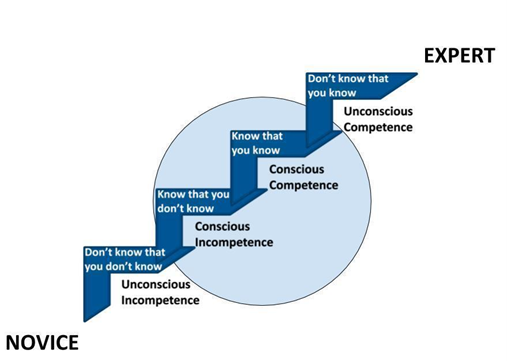
This transformational process is complicated by power dynamics in traditional mentoring between an expert faculty member and a novice graduate student. By virtue of their expertise, faculty mentors provide crucial feedback and guidance as graduate students are enculturated into CRWS. Expert mentors help novices navigate existing field conversations and develop their own areas of interest, from cultivating initial ideas for research to guiding students through institutional “checkpoints.” Expert mentors provide discipline-specific and generative feedback on writing and thinking, through both university gatekeeping practices (like comprehensive exams and dissertation defenses) and opportunities to publish together. Expert mentors convey status and authority to newcomers (McGuire and Reger). In short, expert faculty mentors often hold the keys to doors that block graduate student success, giving faculty mentors considerable power that they may be able to minimize but cannot fully remove from the relationship (Miles and Burnett).
On the other hand, this transformative process affects more than graduate students’ knowledge. As graduate students acquire disciplinary lenses with which to encounter the world, they simultaneously let go of (or are stripped of) previous, comfortable ways. As they oscillate between various stages of competence, they experience liminality, or a “transitional” state that is “fraught with uncertainty, characterized by imitation, mimicry, frustration, and resistance” that comes with a “sense of loss” (Luskey and Emery 2021). Along the way, learners may become “stuck.” This is an emotional experience, and emotions play a key role in supporting or disrupting learning (Cavanagh) despite a dearth of theorizing about emotion’s role in higher education (Bosanquet and Cahir; Timmermans and Meyer). The emotional toll of this process may be particularly important for supporting graduate students as they develop deep expertise in an area. At the same time, graduate students may feel uncomfortable at the idea of sharing these emotional experiences with their mentors, especially if they want to “demonstrate competence in order to appear intelligent, gain status, and acquire recognition and praise” (Lovett et al. 89). Essentially, power dynamics that will always be at play in expert-novice mentoring can complicate, or be complicated by, inherent and unavoidable differences in expertise.
Horizontal mentors may be more effective at supporting each other during these states of liminality both because of a more equal distribution of power between them and because they are in a similar process of consciously integrating new and prior knowledge. Many of the challenges we faced working with expert mentors relate to challenges of power and emotional expression, and Sprague and Stuart’s model has helped us understand that we, and other graduate students, may hit stumbling blocks that expert faculty mentors are less prepared to help their mentees overcome. Instead, it is in these moments that graduate students will benefit from having established horizontal mentoring relationships with others who are also oscillating between various levels of competence and who have not yet crossed the threshold into “unconscious competence.”
Horizontal Mentoring in Action: Our Experience as Doctoral Candidates
Because horizontal mentoring practices are often invisible to faculty mentors, we want to pause here to unpack an example from our own experiences that reflects a common place where doctoral students get “stuck” in their process: the conceptual frame. Our relationship is somewhat different from other discussions of horizontal mentoring in that Caitlin was two years “ahead” of Mandy in our program. After two years of coursework together, Caitlin began the comprehensive exam and dissertation process, while Mandy earned her MA and began two years of coursework required for her PhD. Our two years of closely working together in the classroom context helped solidify our sense of each other as equals, and Mandy’s scholarship on graduate student writing development provided her knowledge about how graduate students navigate the dissertation process.
Because of Mandy’s scholarly interests, she was well-positioned to help Caitlin when she struggled to explain the methodological framework of her dissertation. In late 2020, Caitlin’s challenges with her methodology came to a boiling point as she wrote her dissertation. She had written her initial methodological frame two years earlier in her prospectus, but she found that the initial description was insufficient to analyze the rich data she had uncovered through her mixed-methods research. Caitlin struggled, however, to integrate other theories that she knew could be useful. Our mentor offered additional theories to consider (ones that our mentor had internalized as a seasoned expert in our field and in the research process), but Caitlin was convinced she did not understand them—even as she talked through her notes on the readings and explained how they might relate to her data during weekly video meetings. Caitlin had put up an emotional wall that stood between her and her ability to use these theories that she was convinced she would never understand.
Around the same time, Mandy passed her comprehensive exam and began to write her dissertation prospectus. She found it freeing to finally be “rid of” the examination hurdle and found herself writing her prospectus with renewed energy. Her interests in learning theories and graduate student writing development (a featured topic in her prospectus) really resonated with her as she was finally able to take ownership of her own conceptual frame. Many of Mandy’s meetings with our shared mentor discussed the challenges students typically faced while dissertating as this directly fell under Mandy’s area of study.
During one Zoom meeting, our mentor was honest and direct with Caitlin. “Every doctoral student I’ve worked with has hit a wall here,” she said. “I was just telling Mandy, because she’s starting to write her methodology, that I keep trying different things to get grad students over this hump, but it constantly comes up. This is a hard task, and you’ll get through it.” This kind of comment was not uncommon. In fact, before the pandemic, it was quite normal for the three of us to have shared, informal conversations about both of our projects. Caitlin was reassured to hear that her struggle was not abnormal or a sign of personal failure and she was reminded that our mentor had confidence in her.
Whether intended by our mentor or not, Caitlin took this conversation as a sign to talk with Mandy. In a truly kairotic moment, it was not long after this meeting that Mandy reached out asking if Caitlin would read a draft of her methodology. Even with very different projects, we both drew from similar theories for our methodology. As Caitlin read Mandy’s draft, something clicked. She noticed that Mandy had more control over theories, whereas Caitlin’s own haphazard drafts felt like the theories were controlling her. She replied, “If I send mine later today, could we have a chat?”
After Mandy agreed, Caitlin sat down at the table to write (yet another) draft of her methodology, this time without opening any of her previous drafts or resources. After only a couple of hours, she sent the muddy draft off to Mandy and was excited for a phone call. She paced around the living room as Mandy read a sentence or two and then interpreted what she thought Caitlin meant. “No, no,” Caitlin replied. “I really mean this.” Caitlin spoke in fits and starts as Mandy took notes on a shared document. We moved seemingly in circles, back and forth between each other’s conceptual frames. We asked questions, we summarized the other, and together we worked out the kinks in our understanding of these theories and how they applied to our projects. The next week, Caitlin was able to confidently share a draft of her methodology with our mentor.
This example, we think, illustrates how expert and horizontal mentoring complement each other to support graduate student development. In it, we see our expert mentor provide encouragement by reassuring Caitlin that this is not an uncommon occurrence for doctoral students. Our mentor also provided expert guidance by pointing Caitlin to articles, reading her notes about them, and validating her understanding. But Caitlin had a mental and emotional barrier that kept her from seeing the connections she needed to see to believe she “understood.” Because our mentor had already integrated those ideas into how she viewed the work of CRWS, she could not “unsee” the connections that were clear to her and not-yet-clear to Caitlin. Instead, she needed to talk with someone who was also oscillating between conscious competence and conscious incompetence, whose connections between the ideas were fresh in her mind and not-yet-fully integrated. By talking with Mandy, Caitlin was able to work out her understanding and articulate those ideas in a way that made sense to someone else.
This example also illustrates other benefits of horizontal mentoring that complement expert mentoring models. In this example, we were able to support each other much more quickly than an expert mentor could have, an affordance that became even more apparent as we shifted to online work and no longer had the luxury of walking into our mentor’s office or running into her in the hallway for a quick chat. Instead of sending an uncertain draft to our mentor via email and waiting for the reply, and then waiting again for a meeting to discuss her feedback—a process that is fair and reasonable and we are not criticizing—we went from requesting a chat to sharing drafts to chatting in just a few hours. As a result, Caitlin got to work out what she meant when her thoughts were still very fresh in her mind, something she personally benefits from. In addition, our years-long mentorship, at this point, had led us to a comfortable rhythm and practice. Our mentor sometimes took notes on what we said and shared them with us, but our horizontal mentorship meant that Mandy knew how to add notes to Caitlin’s document in a useful way. And, finally, Caitlin experienced less anxiety sharing this draft with Mandy than she would have felt sending the two-hour-draft to our mentor, even though our mentor is encouraging and supportive.
This example also illustrates the truly recursive process of learning. Doctoral candidates, especially, oscillate between conscious incompetence and conscious competence. It illustrates how a graduate colleague in a similar state of oscillation/learning may be most effective at supporting other graduate students through these liminal struggles: they can offer strategies they have used, raise questions they are still uncertain of, and validate and normalize feelings of uncertainty. Though our example demonstrates the benefits in the context of remote work, none of this would have been possible without our existing mentoring relationship—something we had initially stumbled into because of our shared interest and experiences.
How Graduate Departments, Programs, and Faculty Members Can Encourage Horizontal Mentoring
Learning theories make it clear that graduate students benefit from opportunities to mentor each other, and our example illustrates how that mentoring complements traditional mentoring relationships. We turn now to the institutional affordances and constraints that made our relationship possible, as these are the places where graduate mentors—whether they are assigned mentors, dissertation advisors and committee members, or graduate program directors—have opportunities to effect change in their own programs to encourage students to develop horizontal mentoring relationships. We were lucky to develop this relationship before we knew what horizontal mentoring was, but we believe many graduate students and the overall field of CRWS can benefit from more intentional horizontal mentoring.
Faculty members in graduate programs can support graduate students best by creating structures that allow them to develop meaningful horizontal mentoring relationships. In particular, we recommend that faculty members encourage graduate students to develop horizontal mentoring networks by promoting a culture of camaraderie rather than competition; supporting graduate students in their efforts to mentor each other; providing opportunities for informal, short-term mentoring; and soliciting feedback from graduate students about the mentoring that can best support them. Graduate students may be engaged in horizontal mentoring practices without specifically naming this relationship, and faculty mentors can help them further develop these relationships.
Promote Culture of Graduate Camaraderie
One of the reasons that our horizontal mentoring practice was effective is because we never felt in competition with the other—despite our similar research interests—for a mentor’s time or for opportunities. In general, our graduate program prides itself on the relationships that students build with each other. Without such a collegial spirit, it may be difficult for graduate students to shake off feelings of imposter syndrome and be liminal with each other. These relationships begin in the graduate seminar, where students may engage in performative behaviors to demonstrate their knowledge in ways that can be read or felt as antagonistic by peers. The work of interpreting and understanding readings requires deliberation that sometimes becomes a hostile argument—something we experienced in several of our own graduate seminars. Helping each other manage these experiences and feelings was part of the inception of our horizontal mentoring relationship.
Fortunately, there are some strategies that faculty members who teach graduate seminars can use to help facilitate more collegial relationships. For example, one faculty member teaching literary theory was particularly effective at encouraging collegiality over competition. When Caitlin enrolled in a graduate seminar with them, the instructor established several ground rules meant to discourage what they described as academic posturing that can stand in the way of graduate students learning from each other. They greeted the class as “theorists” rather than students and established during the first seminar meeting that we were all learning together, regardless of previous experiences with literary theory. This professor was also careful to encourage all students to participate in class, using small group activities to encourage us to talk with each other. The faculty member intentionally navigated instances where theorists responded to each other in less than respectful ways, seeing these moments as an opportunity to reinforce deliberation over argument. By setting a tone that embraced the liminality of learners, this professor helped to cultivate a culture that encouraged graduate students to work together that extended outside the classroom walls.
Graduate programs and faculty members can also encourage these collegial relationships by creating opportunities for students in the program to interact in less formal, non-academic ways. This may be especially important for students who are enrolled in online graduate programs (or recent cohorts who began their graduate studies in virtual spaces) with little opportunity to interact synchronously or outside of video meetings and discussion boards. Departments could host “welcome back” parties and other social events that give graduate students the opportunity to meet both faculty members and advanced students they may not take courses with. Talking with graduate students about their non-academic pursuits during these events will also encourage graduate students to participate in similar conversations, getting to know other students on a personal and not just academic level. Because faculty members are consistent members of the department, their actions can go a long way toward setting the tone and expectations for how graduate students interact with each other. Explicitly attempting to foster collegial relationships among graduate students is key to making horizontal mentoring an integral part of a graduate program.
Create Multiple Opportunities to Engage in Short-Term Horizontal Mentoring
A vital component of horizontal mentorship is that students may have more access and opportunity to mentor each other. Oftentimes, these relationships arise organically. As our experience exemplifies, long-standing relationships tend to develop on their own. No one “told us” to mentor each other—nor could they have. In fact, we both signed up for a more formal peer mentoring program through our department’s graduate student organization; we were assigned to mentor or be mentored by an alumnus or colleague. Mandy’s relationship with an alumna flourished and led to collaboration at a conference presentation, while Caitlin struggled to make her “co-mentoring” relationship with another graduate student work.
As a result, we do not advocate that graduate faculty members mandate horizontal mentoring. Rather, we want to distinguish between naturally-arising friendships and our horizontal mentorship, although we recognize that they are closely intertwined. Our friendship developed naturally as two people starting graduate programs at the same time and who enjoyed each other’s company. On the other hand, our horizontal mentorship was shaped by the ways we chose to navigate our graduate studies together. We benefited from numerous opportunities to interact in graduate seminars, through the work of our graduate assistantships, and by attending the same professional conferences. We consciously built on these experiences by setting aside time to debrief over dinner at the end of the day and by strategizing how to navigate particular challenges.
These opportunities also enabled us to work with other graduate students, but those relationships often ended at the end of the seminar meeting or work day. This is not inherently negative, but we mention this to say that mentoring is not intuitive and requires a step beyond working together in a defined space. We did not simply take class together and discuss our readings or projects, and we did not only vent about our frustrations (though we did that, too). Instead, we dedicated time and mental energy to working through challenges and problems as they arose, in real time, and often in unexpected places. We see two strategies graduate faculty and mentors can use to help graduate students develop these relationships: first, they can create opportunities for graduate students to engage in more intentional, if informal, mentoring opportunities. Second, which we will return to in the next section, they can help graduate students mentor each other effectively.
Social opportunities organized by graduate programs like those we mentioned in the previous section are an excellent way for graduate students and faculty members to get to know each other in ways that can lead to mentoring relationships. Similar functions can also be designed with mentoring in mind. These events might include more formal workshops or networking events, planned with collaboration and interaction in mind. For example, faculty members in Miami University’s composition and rhetoric program hosted “meet and greet” type sessions for new graduate students to meet all the faculty, not just those teaching seminars their first semester. These sessions included formal introductions of names and research areas, as well as “speed dating” style timed conversations between faculty and students. Our departmental graduate student organization sometimes planned Works in Progress feedback sessions, like those at Research Network Forum or Qualitative Research Network at CCCC, in which one faculty member leads a small group of graduate students to provide feedback on each others’ current projects. If the goal is to encourage horizontal mentoring relationships, faculty members might facilitate similar events with an emphasis on participants’ feedback and ideas rather than their own.
Faculty mentors can also bring students together for intentional, communal mentoring, which may be especially important for students who are less involved in the campus community, such as those who take class part time, travel a great distance for on-campus obligations, or who are working on independent projects without the structure of coursework to bring them to campus. Faculty members who serve as dissertation readers or advisors might engage in communal mentoring of several students who work with them by meeting as a group rather than with individuals. Doing so can create a dynamic for students to learn from and with each other. Even a one-off meeting where students are encouraged to meet again to check in on their progress can encourage graduate students to see their peers as potential mentors, whether they develop a sustained mentorship or not. The goal is to introduce them to the idea of talking to their colleagues about their work (and not only their academic advisor or major professor).
Finally, graduate mentors can also point out if there are specific spaces on campus that students can use to co-work. Early in our programs, we engaged in limited horizontal mentoring relationships with other students (and friends) by co-working in shared spaces. Once, early in our graduate studies, we worked late into the night in a campus meeting room with several other friends. The whiteboard in the room listed each of our goals for the day, and we paused to cheer when someone was able to mark off or update their goals. Working together in campus meeting spaces enabled us to quickly seek feedback in a moment of stuckness and, importantly, to cheer each other on at busy times of the semester. Not all graduate students will have the access or desire to use campus resources in this way, but faculty mentors can make sure that graduate students know what resources or campus locations are available for working in (like library study rooms or seminar rooms when no class is scheduled). If graduate students make a habit of working and learning together, mentoring relationships can develop organically. This is a lower-stakes strategy programs can use that does not require facilitation, which is different from the kind of group mentoring meetings we suggested above. Instead of facilitating conversations directly, a faculty mentor empowers graduate students to use resources at their disposal to facilitate the work they would complete elsewhere. The ability to use departmental and university resources may encourage graduate students to more organically develop horizontal mentoring relationships with others.
Assist Graduate Students in Mentoring Each Other
Graduate faculty and mentors can also help graduate students intentionally mentor each other. This process is not without challenge because this encouragement can result in unnecessary labor being placed on graduate students without warning. We have both received emails from (and sent them to) other graduate students asking for copies of materials or wanting to talk with us about our projects because a professor had encouraged them to reach out to us. Unfortunately, as graduate students we did not always know what to do in these situations, both as the sender and receiver of these emails. We know that having models of genres can make navigating the independent processes of graduate programs easier, and we recognize that faculty members encouraging these conversations may not expect graduate students to mentor each other. Simply sharing a reading list, for instance, is not the kind of “horizontal mentorship” we advocate for—but these requests seem like a common occurrence in graduate programs and thus are a promising entry point to horizontal mentoring relationships that faculty members can prompt.
When suggesting a graduate student connect with another graduate student, faculty mentors should, at least, be able to explain why that peer will be a strong resource for the student. Faculty mentors might help brainstorm questions or identify topics for the conversation. When Caitlin was feeling stuck on her conceptual frame, our mentor already had a habit of encouraging us to collaborate in specific ways. As another example, Caitlin received an email from another graduate student also working with our mentor. This student asked concrete questions about planning a multi-part research project for her dissertation. Caitlin was able to respond quickly and directly, share relevant documents with commentary about why they might be useful, and ask clarifying questions that could help her provide additional insight to the requesting student. This is a very different request than the occasions when we have received messages requesting a copy of a reading list and rationale, for instance. Faculty members might also consider facilitating this first conversation in a communal mentoring meeting rather than simply encouraging graduate students to “reach out” and “talk to” a colleague.
Faculty mentors can also try to make themselves aware of graduate students who may be consciously learning together. Horizontal mentoring already occurs in many programs, but faculty are often unaware of existing horizontal mentoring relationships and are unable to tap into them as resources for graduate students they mentor. It was not until after we both had earned our PhDs and were working on this article that our mentor explicitly learned of our horizontal mentoring efforts, but she knew that we often worked together in our center and spent time together outside of work and classes. As a result, she was able to encourage us to talk with each other effectively. For example, it was not uncommon for Caitlin to say, “Well, I was talking about this with Mandy” when discussing her dissertation project with our mentor. Because she knew of our regular collaboration and co-working, our mentor was able to explicitly say, “Mandy, I think you need to talk to Caitlin about how to deal with x phenomena” in a way that aided our horizontal mentoring. If advisors and program directors know of students already supporting each other, they could then help students mentor each other even more effectively and in ways that supplement other mentoring students receive. Again, horizontal mentoring does not (and should not) exist as a replacement for traditional mentoring. Both can work well together, and programs and faculty more actively learning about and understanding these dynamics will lead to better overall mentoring.
Solicit Feedback on Students’ Mentoring Needs
Finally, graduate programs and faculty can directly ask students about the kind of mentoring support they need and what kinds of challenges they are facing. A core issue with the traditional expert-novice mentoring dynamic, as we have outlined, is the tendency for the expert to “transmit” their knowledge down to the novice and to additionally assume what the student needs. A way to break that mold is for graduate programs and individual faculty to ask students not only about the mentoring they need but also when or how they want to receive mentoring. A graduate director could administer a survey at the beginning of each year or semester to ask what kind of support graduate students in the program are most interested in or most desire. This survey could include questions about specific challenges students face or who they currently work with as mentors. With these survey results, a graduate director or other faculty mentor can connect individuals around common challenges or create opportunities to bring graduate students together for informal mentoring opportunities that they will see as a benefit. Creating and distributing such a survey provides graduate students with a language to ask for specific kinds of mentoring outside of the survey and establishes a visible culture of mentoring in graduate programs.
This needs assessment can also directly ask students if they are interested in mentoring or receiving mentorship from other students in their program or department. Some graduate students may simply prefer opportunities to work with an expert mentor, even in a department where horizontal mentoring between graduate students is a valued practice. As one early reader of this article responded, some graduate students and scholars of color may not want a horizontal mentor, especially if they are one of only a few BIPOC individuals in their programs. Instead, these students might most benefit from mentors with the experience and the ethos to help them navigate and change the systems of oppression that are core to academia. Temptaous Mckoy, for instance, argues that mentors need to perform specific kinds of labor to more effectively support graduate students of color (Ore et al., Diversity is Not Enough, 249-256)—something that other graduate students may not be prepared or empowered to do. In other cases, graduate students may have experiences or obligations—like a full-time job elsewhere or primary caregiver responsibilities—that make horizontal mentoring unappealing. While we believe that all students can benefit from horizontal mentoring relationships, we do not believe that these relationships should be foisted upon students who have other preferences. Rather than assuming that all mentoring is good for all students, using a needs assessment to determine what actual, individual students in their programs may desire is the most important way for faculty members to support their graduate students.
One of the main reasons for faculty members to solicit input on graduate student mentoring needs is to empower graduate students to ask for what they need. If graduate students enter a program where they are asked about their mentoring needs and then met with responses to those needs, they will feel more comfortable reaching out when they need help or support—and they will reach out to peers and colleagues, not just faculty. These moves create supportive environments for students in which they learn not only from faculty but also from and with each other.
Conclusion
Mentoring is a core part of graduate education across academic disciplines, and it is something that the field of composition, rhetoric, and writing studies takes seriously in its scholarship and practice. Horizontal mentoring is an established practice that many graduate students are likely engaging in without knowing it. Making horizontal mentoring a more intentional and explicit part of their mentoring networks can complement the more common expert-novice mentoring relationship. Because learning is inherently transformative, having mentors of various levels of expertise is an important way to support graduate student learners. One challenge to helping graduate students develop these relationships is that horizontal mentoring more often develops organically between individuals. We believe, however, that such relationships can and should be more intentionally promoted in graduate programs and among graduate students. Graduate programs and faculty can do this by making space for horizontal mentoring to occur.
Our argument is not that faculty need to do more work as they mentor graduate students, but rather that faculty members and graduate program directors bear some responsibility for making (or making visible) institutional structures that support horizontal mentoring. Our own relationship developed in large part due to our overlapping research interests and personal compatibility, and it developed because we had a chance to get to know each other from that initial program recruitment. Graduate programs can shoulder the labor of creating these opportunities intentionally, rather than leaving graduate students to develop such opportunities on their own.
We hope that faculty members who work with and mentor graduate students will more intentionally use strategies that draw on research describing how learners oscillate between stages of expertise. It is especially important to support graduate students to develop horizontal mentoring practices because these relationships can support graduate students in moments of flux and situations beyond their graduate programs. Our relationship helped us navigate many doctoral degree requirements, but it also helps us as we navigate new encounters. Since writing this article, Caitlin has moved to a tenure-track position and Mandy moved into a new, full-time role in the Howe Center for Writing Excellence. Our horizontal mentoring relationship continues to thrive as we collaborate on projects, revise our own writing, and consider the professionals we hope to be in the future. We text each other daily and support each other through major life (and academic) transitions, as well as dedicate physical time and space to be together even after graduate school. Our investment in each other as horizontal mentors, then, is long-term and includes long-term payoffs. Our relationship continues to shape who we are as scholars and researchers as well as human beings. This is arguably one of the most lucrative investments one can make in graduate school and is one that graduate programs would be remiss to ignore or take for granted. It is with this impetus that we push for our field to more fully embrace the generative potential of such a relationship, and to take the time and labor to cultivate conditions for it to grow in graduate programs. The fruit it bears can last long after graduation and make an invaluable impact on not only academics but also on life and mental health.
We hope that sharing some of our experiences may contribute to helping others in our field understand how to help graduate students foster such relationships. Like VanHaitsma and Cesaro, we hope to continue the conversation about the value and practice of horizontal mentoring across many stages and career paths in composition and rhetoric—from graduate school into mid- and late-careers in and beyond academia. While we focus here on the ways that graduate programs and faculty can support this work, we recognize that there are many strands of this conversation that are left out that might more directly support graduate students themselves. We are eager to see the ways that others in the field may take up horizontal mentoring and expand our understanding of this work.
Notes
[1] We would like to thank J. Palmeri, Laura Micciche, Trixie Smith, our editors, and anonymous reviewers for their feedback and encouragement on previous drafts of this article.
Works Cited
Ballif, Michelle, D. Diane Davis, and Roxanne Mountford. Women’s Ways of Making It Rhetoric and Composition. Routledge, 2008.
Björklund, Lars. Why Do They Not See What I See? The Difference Between Knowing How and Knowing That. Transfer, Transitions, and Transformations of Learning, edited by Howard E. Middleton and Liesbeth K. J. Baartman, Sense Publishers, 2013, pp. 149–168.
Bloom, Lynn Z. Mentoring as Mosaic: Life as Guerilla Theater. Composition Studies, vol. 35, no. 2, 2007, pp. 87–99. https://www.jstor.org/stable/43501705.
Bosanquet, Agnes, and Jayde Cahir. ‘What Feelings Didn’t I Experience!’ Affect and Identity in PhD Writing. Research Literacies and Writing Pedagogies for Masters and Doctoral Writers, edited by Cecile Badenhorst and Cally Guerin. Brill, 2015, pp. 132–148.
Bridges, D’Angelo. Sibling-Scholar Network as a Means of Survival in Ore, Wieser, and Cedillo, Diversity is Not Enough, pp. 230–234.
Cavanagh, Sarah Rose. The Spark of Learning: Energizing the College Classroom with the Science of Emotion. West Virginia UP, 2016.
CCCC Statement of Professional Guidance for Mentoring Graduate Students. Conference on College Composition and Communication, 5 Dec. 2019, https://cccc.ncte.org/cccc/resources/positions/professional-guidance-for-mentoring-graduate-students/.
Corey, Jessica Rose, and Nicole I. Caswell. ‘Just a Graduate Student’: Doctoral Students in Writing Program Administration Positions. In Progress, vol. 3, Fall 2013, http://inprogressjournal.net/archives/current-issue-2/just-a-graduate-student-doctoral-students-in-writing-program-administrative-positions/.
Eble, Michelle F., and Lynée Lewis Gaillet, editors. Stories of Mentoring: Theory and Praxis. Parlor P, 2008.
Eby, Lillian T. Alternative Forms of Mentoring in Changing Organizational Environments: A Conceptual Extension of the Mentoring Literature. Journal of Vocational Behavior, vol. 51, no. 1, 1997, pp. 125–144. https://doi.org/10.1006/jvbe.1997.1594.
Garcia, Christine, et al. ‘It’s Not You. You Belong Here.’ A Latinx Conversation on Mentorship and Belonging in the Academy. Diversity is Not Justice: Working Towards Radical Transformation and Racial Equity in the Discipline, special issue of Composition Studies, vol. 49, no. 2, 2021, pp. 53–69. https://compstudiesjournal.com/wp-content/uploads/2021/10/garcia-campos-de-mueller-cedillo.pdf.
Hinds, Pamela J. The Curse of Expertise: The Effects of Expertise and Debiasing Methods on Prediction of Novice Performance. Journal of Experimental Psychology: Applied, vol. 5, no. 2, 1999, pp. 205–221.
Lovett, Marsha C., Michael W. Bridges, Michele DiPietro, Susan A. Ambrose, and Marie K. Norman. How Learning Works: Seven Research-Based Principles for Smart Teaching. 2nd edition, Jossey-Bass, 2023.
Luskey, Matthew, and Daniel L. Emery. Beyond Conventions: Liminality as a Feature of the WEC Faculty Development. Writing-Enriched Curricula: Models of Faculty-Driven and Departmental Transformation, edited by Chris M. Anson and Pamela Flash, The WAC Clearinghouse; UP of Colorado, 2021, pp. 95–120. https://doi.org/10.37514/PER-B.2021.1299.2.04.
McGuire, Gail M., and Jo Reger. Feminist Co-Mentoring: A Model for Academic Professional Development. NWSA Journal, vol. 15, no. 1, 2003, pp. 54–72. https://www.jstor.org/stable/4316944.
Meyer, Jan H. F., and Ray Land. Threshold Concepts and Troublesome Knowledge: Linkages to Ways of Thinking and Practising within the Disciplines. Proceedings of the 2002 10th International Symposium: Improving Student Learning Theory and Practice—10 Years On, edited by Chris Rust, The Oxford Centre for Staff and Learning Development, 2003, pp. 1–12.
Miles, Katherine S., and Rebecca E. Burnett. The Minutia of Mentorships: Reflections on Professional Development. Stories of Mentoring: Theory and Praxis, edited by Michelle F. Eble and Lynée Lewis Gaillet, Parlor P, 2008, pp. 113–128.
Moss, Pamela, Karen J. Debres, Altha Cravey, Jennifer Hyndman, Katherine K. Hirschboek, and Michele Masucci. Toward Mentoring as Feminist Praxis: Strategies for Ourselves and Others. Journal of Geography in Higher Education, vol. 23, no. 3, 1999, pp. 413–27. https://doi.org/10.1080/03098269985371.
National Research Council. How People Learn: Brain, Mind, Experience, and School. National Academy P, 2000.
Ore, Ersula, Kim Wieser, and Christina V. Cedillo, Symposium: Diversity is Not Enough: Mentorship and Community-Building as Antiracist Praxis. Rhetoric Review, vol. 40, no. 3, 2021, pp. 207–256. https://doi.org/10.1080/07350198.2021.1935157.
———. Symposium: Diversity is Not Justice: Working toward Radical Transformation and Racial Equity in the Discipline. College Composition and Communication, vol. 72, no. 4, 2021, pp. 601–620. https://doi.org/10.58680/ccc202131443.
Ribero, Ana Milena, and Sonia C. Arellano. Advocating Comadrismo: A Feminist Mentoring Approach for Latinas in Rhetoric and Composition. Peitho, vol. 21, no. 2, 2019, pp. 334–356. https://cfshrc.org/wp-content/uploads/2019/03/RiberoArellano_IV_Advocating-Comadrismo-2.pdf.
Rodrigo, Shelley, Susan Miller-Cochran, Duane Roen, Elaine Jolayemi, Cheri LeMieux Spiegel, and Catrina Mitchum. DIY Mentoring: Developing Personal Learning Networks. enculturation, 2014, http://www.enculturation.net/diymentoring.
Simpson, Steve. The Problem of Graduate-Level Writing Support: Building a Cross-Campus Graduate Writing Initiative. WPA: Writing Program Administration, vol. 36, no. 1, 2012, pp. 95–118.
Sprague, Jo, and Douglass Stuart. The Speaker’s Handbook. Harcourt College Publishers, 2000.
Timmermans, Julie A., and Jan H. F. Meyer. Embedding Affect in the Threshold Concepts Framework. Threshold Concepts on the Edge, edited by Julie A. Timmermans and Ray Land. Brill, 2019, pp. 51–67.
VanHaitsma, Pamela, and Steph Ceraso. ‘Making It’ in the Academy through Horizontal Mentoring. Peitho, vol. 19, no. 2, 2017, pp. 210–233. https://cfshrc.org/article/making-it-in-the-academy-through-horizontal-mentoring.