
Abstract
Students in the Writing Arts Department at Rowan University have multiple opportunities to publish their writing and to facilitate the publishing of others. In this program profile, one faculty member and four former students describe how these opportunities engage students in publishing literacies that foster moments of intellectual risk and failure. While much has been written about risk and failure within the classroom, we propose a framework for extending these literacies beyond it via a programmatic culture centered on a do-it-yourself (DIY) ethos. We outline four characteristics of this ethos and apply them to curricular, co-curricular, and extracurricular examples, ending with some limitations to this approach.
Keywords
Publishing; Public writing; Writing majors; DIY
Introduction
For students pursuing degrees in writing, achieving an authentic or affective sense of authorship is often the goal of a professionalizing process that begins in first-year writing and continues through majors via English or writing departments like ours at Rowan University, and on through to graduate programs. In this profile, one faculty member and four former students share how this process unfolds in the Department of Writing Arts, one of the few independent writing departments in the United States. At the heart of this experience, we argue, are multiple and overlapping curricular, co-curricular, and extracurricular encounters that foster risk-taking through publication and public writing—risks that often lead to misfires, accidents, and failures and, therefore, reiteration and (eventually) sustained public emergence. In sharing our work, we hope to suggest that fostering risk and failure are inherent to a professionalization process that, perhaps paradoxically, refutes authorization. That is, by questioning the role that classrooms alone play in the process of becoming an author, we invite a broader interrogation into who or what authorizes authorship and offer one framework—one centered on DIY ethics—that attempts to generalize from our experiences.
The Writing Arts Department at Rowan University is expansive and home to several programs, including first-year writing, a B.A. in Writing Arts, and an M.A. in Writing. Majors pursuing the B.A. often declare one of three concentrations: Creative Writing, Publishing and Writing for the Public, or Technical and Professional Writing. [1] More importantly for our purposes in this profile, in addition to the classes offered through the major and graduate program, students have ample and sustained opportunities to publish in one of four publications. In fact, publishing is so deeply embedded in the Department’s identity that one of them, our undergraduate literary magazine Avant, predates its origins as the second-oldest student organization on campus (founded in 1960). Collectively, thanks in part to these opportunities and publications, as well as a B.A./M.A. dual degree program, there is often much commingling and integration between undergraduate and graduate students, which in turn fosters a culture of publishing within the department.
That culture also makes sense given the inherent risk in its roots. In 1966, six faculty left the English Department, separating themselves from the study of literature to focus on the teaching of public relations and journalism via a communication department. For the next 30 years, that department grew into a much larger one; in fact, it eventually grew to be so large that it spawned a school with five programs which had departments nested within them. In 1992, thanks to a $100 million donation from engineer and wealthy business owner Henry Rowan (the largest one made to a public college in the history of higher education at that time), Glassboro State College became Rowan College of New Jersey. A few years later, in 1996, writing became a standalone department, called College Writing, housed within the School of Communication where it was primarily a first-year writing program.
The aughts saw several changes that directly affect it to this day. In 2001, the Department was briefly renamed the Department of Composition and Rhetoric; however, in 2004 it merged with Creative Writing (which was previously paired with the Journalism Department), and as a result changed its name to Writing Arts, offering a B.A. for the first time, in 2005. After several years of integration with other units and colleges and the creation of a writing center in 2009, Writing Arts electives—which previously focused heavily on creative writing—shifted in 2013 into three distinct concentrations: Creative Writing, Technical and Professional Writing, and New Media Writing and Publishing. The major has retained these concentrations since, except for one: in 2019, New Media Writing and Publishing became Publishing and Writing for the Public, reflecting the Department’s increasing emphasis on the publicness of writing. [2]
A principal focus of this concentration—which also became a minor—is to provide opportunities for students to engage with various publics by exploring the relationship between networks and the limited means of production authors often draw from to address those publics. This emphasis on networks, circulation, and tools for production widened the scope of study in ways that made the concentration and minor distinct but also followed in the footsteps of other writing and rhetoric programs in the United States. [3] While new media was helpful for reconceptualizing how reading and writing operated differently during the rise of Web 2.0, by focusing on publics, we have reframed the concentration to be more capacious and rhetorically focused to think both theoretically and practically about the relationship between readers, writers, technologies, and the social and cultural spaces these create. Such a pivot feels even more crucial now that the preeminent new media writing technologies are corporate large language models such as ChatGPT. [4]
The concentration is currently twelve credits and requires students to take six of them from a bank that include classes like Self-Publishing and Editing for Publication. Students may take the other six from electives such as Writing About Pop Culture, Writing Comedy, and several others both within and outside the Department. And while this Program Profile will discuss some of these classes in more depth below, it is important to emphasize a few factors before explaining how the program engages with risk and failure through public writing.
First, our major is on the verge of implementing a significant revision, increasing the overall credits from 37 to 40 and changing course banks to further expose students to the Publishing and Writing for the Public writing specializations. Students will choose either Self-Publishing or Editing for Publication as part of their introductory sequence, and a new class—Writing, Identity, and Power—will ask students to use “witnessing” as a tool for listening to and representing marginalized voices, and for practicing writing strategies that challenge oppressive norms and advocate for social justice. Students will also be responsible for taking a capstone course where they will shape their work into an independently directed creative, technical, scholarly, or public-facing project.
Second, while the Writing Arts major is an important component of our department’s identity, it is enmeshed with our M.A. in Writing. Not only do many students who earn their B.A. go on to pursue the M.A., but they also take graduate classes through senior privilege or our dual degree program. For instance, students may satisfy elective credits in the Publishing and Writing for the Public concentration by taking one or both graduate classes: Editing the Literary Journal and Professions in Publishing.
Finally, one of the main arguments we are making in this profile is that this is but one curricular element of a larger program that provides encounters with risk and failure. While we will flesh out some of the classes and various creative, academic, and multimodal forms and genres students are exposed to, in what follows we will also detail co- and extracurricular experiences that are instrumental in fostering a programmatic culture that attempts to normalize publishing via sustained opportunities to create and reach publics.
Before doing that, however, we aim to articulate the relationship between publishing, risk, and failure. While there is an obvious correlation between public writing and risk, especially for pre-professionals, in the next section we share how publishing has become more accessible and participatory in the digital age, and as a result, it underscores the importance of cultivating a programmatic, do-it-yourself (DIY) approach that helps students understand that the relationship between writing and publishing is more than merely finding an agent or writing a query letter, but that publishing is itself a literacy and one that requires tactics of perseverance by providing opportunities for authentic vulnerability.
Risk, Failure, and Publishing
The fundamental curse of authorship is captured pithily by Stephen Marche in his book On Writing and Failure: “Failure is the body of a writer’s life. Success is only ever an attire. A paradox defines this business: The public only sees writers in their victories, but their real lives are mostly in defeat” (7–8). If we succeed at all, he suggests, it might come fleetingly, and even then, we can never really be sure our readers are interpreting our work the way we want.
Perseverance in publishing, of course, has historically been defined via a gatekept culture industry that controls access to publics. However, these intermediaries have changed significantly in the last twenty years, leading us into an era of what Marche ominously calls “an aftermath,” a “golden age [that] has given way to an age of chaos” (14). The chaos he speaks of is the digital age, where the proliferation of freelancers and self-publishers are more common than the stable anointed positions of “editors” or “writers,” many of whom cannot even be verified as human as the advent of generative AI and algorithmic publics have led to disconcerting levels of hyperabundance.
While such hyperabundance has not led to the collapse of legacy presses, traditional models of professional publishing, nor book culture in general, it does suggest that we need to consider what it means to publish—and the many possible pathways a writer can take to reach public audiences. In fact, for many of us in Writing Arts it means reducing the gap between the idea of authorship and publishing in such a way that publishing itself becomes a literacy practice.
In Mass Authorship and the Rise of Self-Publishing, Timothy Laquintano explains how such literacy practices respond to digital infrastructures where everyday publics participate in publishing, from authoring their own self-published romance novels, to reviewing books on sites like Goodreads or BookTok. These literate activities differ from someone publishing as a professional or within an industry as the question of success goes beyond sales and reviews; rather, successful publishing happens because it is made meaningful through mediation. By defining publishing as a widespread literate practice in our programs, students conceive, design, and circulate all kinds of meaningful and multimodal “focal texts” (Prior, qtd. in Laquintano 15)—books, zines, podcasts, websites, and more, which we discuss more below.
To be clear, some students who graduate from Writing Arts go on to become professionals in the publishing industry (especially those who complete our M.A.); however, much of the goal throughout our program is to teach students how publishing is a literacy practice and how many of those practices are best taught through a mix of experiences, with a range of intermediaries, and both in the classroom and out. Given the fact that a writer’s success or failure is often measured through net readership or stranger sociability, it’s important to conceive of publishing literacies capaciously.
Yet, much of the scholarship in Writing Studies on risk and failure pedagogies is concerned with writing in the classroom, placing focus on curricular, instructional, and assessment practices that either encourage or discourage students to create opportunities to reflect on, experience, or anticipate failure. While there are certainly studies that have examined pedagogical failure from perspectives outside the classroom [7], as with most pedagogical research in our field, the de facto site places agency with the instructor.
For instance, in their comprehensive review of scholarship on failure pedagogies, Teagarden, et al. (Counterpoint) examined 24 articles, chapters, and books published between 1996–2023 and identified three dominant purposes when teaching failure. They noticed that these approaches aligned with classical rhetoric’s branches of oratory: forensic (focused on the past), the epideictic (focused on the present), and the deliberative (focused on the future). The anticipatory aspect of this last approach, they argue, is really about risk more than failure; as such, they suggest intellectual risk as a more goal-oriented engagement that embeds writers in the context of communities that determine what success or failure might look like. As they suggest, “the advantage of focusing on ‘intellectual risk taking’ in the classroom (instead of focusing on failure), is that it can offer a more positive learning goal for students” (57).
We agree and believe that such intellectual risk can also be fostered at the programmatic level by situating publishing as an essential outcome of all reading and writing. In what follows we suggest that one way of pursuing intellectual risk-taking through publishing literacies is by espousing a DIY ethos that starts in the classroom but extends beyond it through co-curricular and extracurricular scenes of activity. Such an ethos, we contend, challenges the idea that authorship is limited to the realm of professionals, normalizing publishing as a literacy practice.
After briefly proposing what we call a DIY ethical framework, we use these curricular distinctions to draw attention to the ways in which publishing is woven into the fabric of Writing Arts, giving students experiences with various genres (cultural criticism, satire, poetry and fiction), platforms (zines, podcasts, literary journals, digital magazines, ebooks), and roles (writers, editors, designers, marketers, reviewers) as well as opportunities to define success and failure through collaboration and often ad-hoc processes that are responsive to the goals at hand.
DIY Ethical Framework: Four Essential Practices
In her oft-cited 2005 book DIY: The Rise of Lo-Fi Culture, Amy Spencer defines the DIY ethos simply as “the urge to create a new cultural form and transmit it to others on your own terms” (14). From self-published zines to pirate radio, Spencer provides renderings of these forms, underscoring the gritty, “lo-fi” means by which creators circulate them via distros or mail order, verboten airwaves, 4-track cassette recorders, or instruments improvised from junk. Indeed, the “urge” Spencer describes is animated by the innovative ways participants commandeer technologies for creative control. In Adjusted Margin: Xerography, Art, and Activism in the Late Twentieth Century, Kate Eichhorn gives the example of the copy machine:
Emerging in the early 1970s just as copy machines started to move out of offices and libraries and into bodegas and copy shops, New York’s downtown scene benefited from this new form of inexpensive print production from the outset: musicians without agents lined up at copy machines to turn out homemade posters advertising upcoming gigs; downtown artists embraced copy machines as a way to move their art out of the gallery and museum and into the street; and writers seized copy machines as a way to self-publish zines, broadsides, and even books. (89–90)
Often traced back to the punk movements of the 1970s, the DIY ethos projects a productive mythos, a narrative that begins with an artist or collective using everyday technologies to circumvent or transgress mainstream homogeneity or corporate authority in the pursuit of agency and organizational independence. This negation leads the artist to produce alternative forms, as both Spencer and Eichhorn note, but also DIY networks, scenes, and spaces.
Writing programs or student-led organizations that want to foster risk and failure through publishing can and should likewise cultivate scenes or create spaces that empower writers by considering overlapping practices that are animated by this DIY ethos. In what follows, we identify four: (1) making do, (2) tinkering, (3) emergence, and (4) creative entrepreneurship. After reviewing these practices in brief, we describe how we’ve engaged them across several publications and projects in Writing Arts. The projects we share vary in terms of media and scope, from selling gritty zines at a community literary festival to running a national literary magazine. We thus end by sharing advice for departments or student organizations interested in applying these practices to their own varied contexts and specific goals.
Space precludes an exhaustive review of interdisciplinary scholarship on DIY culture and its attendant histories and ethics, which span a range of discourses and sites from makerspaces to punk scenes to healthcare (see Kohtala et al. for a helpful overview of this history). Thus, the four DIY-based practices we share below are based on a distillation of sources, as well as a synthesis of our own experiences working on these projects over the last five years. While we present these practices as distinct, they often overlap, synthesize, or collide. Tinkering, for instance, is often the outcome of making do, but both practices can create new problems for entrepreneurship and continuity/emergence.
- Making do—By “making do” we refer to the ways in which self-publishers use, assemble, or bricolage, as Frank Farmer notes, the available literacies, materials, resources, and bodies at hand to create or distribute their work. The self-publishing examples we illustrate in this profile have emerged from these, as well as collaborations and assemblages of activity that leverage the talents and aspirations of students. Drawing from these resources is not incidental but purposeful and, we argue, critically so, seeking alternative material and cultural arrangements by doing more with less. As Luther et al. note, “Making do is often an act of reclaiming agency in contexts of structural disempowerment while working around established systems.” Moreover, DIY is often a rhetorical and material response to the “readymade”—inherited forms, sites, and practices that are routinely used without question. In the examples we provide, we make do by using open source (Audacity, WordPress) and proprietary platforms (Discord), public events (a book festival), and everyday tools like the Internet Archive, photocopiers, Google Drive, iPhones, and Chromebooks.
- Tinkering—Tinkering calls attention to the material aspects of authorship: the “sixth mode” of multimodality—the tactile—as Este Beck argues in her exploration of makerspaces, but also the textual, as Danielle Koupf suggests in forwarding a theory of creative-critical tinkering. For both authors, tinkering offers possibilities through experimentation — with things, tools, and language — as an open-ended process of invention that invites play. In this sense, tinkering is a way of fostering what Teagarden et al. (Writing Classroom) call a “rhetorical approach to intellectual risk-taking,” wherein students must design or invent writing projects with minimal conventions, seek opportunities to test out ideas, and reflect upon their choices to develop their own sense of success or failure (129). While intellectual risk is often explored in relation to the classroom, we propose extending it to consider risk via any encounter with varying roles, modes, or media that reach publics. Tinkering resists lockstep processes, which is what makes it both powerful and unpredictable, especially when combined with the resourcefulness of making do. Steph Ceraso and Matthew Pavesich share how DIY approaches to design-based learning can be encapsulated through what one makerspace director describes as “the squiggle,” a drawing of the nonlinear process that requires students “to be creative, to generate multiple competing big ideas, to test them, to fail, and to re-start” (np). In other words, students conceive of and attempt to execute a plan with the understanding a plan is not a script. In a tinkering model of publishing, students learn that time and materials aren’t unlimited; assumptions are not often safe; audiences aren’t as predictable as they seem; texts and assets need to be spliced, rearranged, or overwritten.
- Emergence—DIY’s emphasis on self-determination and amateurism risks valorizing the individual and thus obscuring what is often an intensely mediated and social process of learning, where creations and happenings are the result of people working together (amateurs with professionals) and creators learning to appropriate or use certain tools (occasionally rag-tag, but also state-of-the-art). This has pushed some to shift the phrase from “DIY” to “DIO” (do it ourselves) or “DIWO” (do it with others), emphasizing the communal and pedagogical experiences of DIY culture. Indeed, as Frank Farmer has noted, the DIY ethos often leads to the creation of a cultural public, and with this kind of worldmaking, authorization isn’t appointed by single origin but emerges from the ethical entanglements or intra-actions between writers and materials—what Leigh Gruwell describes as craft agency (15). This is compatible with recent discussions of grounded forms of activism such as adrienne maree brown’s concept of emergent strategy, as well as theories of relationality articulated by Ann Shivers-McNair in her book-length study of makerspaces. The projects we share each have their own conditions of emergence, where certain bodies, intermediaries, or resources lead to new opportunities—or where we purposely avoid others because of their potential limitations.
- Creative entrepreneurship—Invariably scholars have challenged DIY’s gutterpunk roots on grounds that it not only fails to escape consumer culture but participates in it. In DIY Style, for instance, Brent Luvaas argues that “It would be a mistake… to hold up the DIY ethos as an idealistic alternative to the logic of contemporary capitalism. DIY… is also one of the very ideological pillars upon which contemporary capitalism rests, that creative, experimental, go-getter, and be-yourself spirit that drives innovation and fuels ever more active modes of consumption” (6). Likewise, as Teagarden et al. (Writing Classroom) point out, entrepreneurial risk can be linked problematically to naturalized commercialization (119). At the same time, while it is impossible to avoid the prosumptive aspects of DIY culture, it can be useful to consider more progressive conceptions of its entanglements with capitalism. In his zine on crowdfunding, for instance, Craighton Berman shares a model for creative entrepreneurship, arguing for a fiercely independent conception of design (as with writing) that is not just in service to others. Crowdfunding uses the necessity of capital as an exigence for sharing one’s most original, unbridled ideas with others. In the projects we detail below, students price and pitch zines at a table at a book festival, innovate by searching and remixing artifacts from the public domain, and use social media to compete for the attention of readers.
While these four practices are hardly exhaustive when it comes to independent publishing practices, we argue that a DIY ethic can inspire messy, authentic, and ultimately productive experiences for student writers, inviting them to recover lost or marginalized voices, attend to issues of representation in pop culture, and make use of radical, feminist media like zines. While many of these projects originated from faculty members from the Department of Writing Arts over a five-year period, four former Writing Arts students collaborate here to explain how these practices manifested through a mix of coursework through classes like Self-Publishing, Introduction to Writing Arts, Writing About Pop Culture, Editing the Book, Editing the Literary Journal, as well as co- or extracurricular experiences by tabling with zines at a literary event (Collingswood Book Festival), producing podcasts (The Phono Project), publishing a digital magazine dedicated to pop culture (Halftone), editing self-publishers (Singularity Press), and running literary journals (Glassworks and Avant). [5]
Making Do and Tinkering
Often when we ask students to produce and circulate self-made publications, we start with the tools and resources already within reach on our campuses, in our communities, and within our homes. The first step in “making do,” then, means taking stock of what’s around us physically, including machines and raw materials, but also institutions and cultures. Part of incorporating a DIY ethos via curriculum means developing an inventory of these resources as teachers but also helping students do this as a habit of mind.
It also means testing the capacities and limits of these tools by tinkering with them, looking for opportunities to arrange, assemble, or combine certain materials using various tools—and disassembling or rearranging when the results don’t quite work out. Assessing these successes and failures varies tremendously, depending on the context.
One obvious way to introduce students to making do and tinkering is through zines, “non-commercial, small circulation publications which are produced and distributed by their creators” (Spencer 17). As a grassroots form of self-publishing, zines offer an alternative to traditional publishing houses and corporate gatekeepers. At its most basic level, they require nothing more than paper, a printer, and some binding, yet the possibilities for transforming these tools into publications are wide-ranging.
Most students in Writing Arts are first introduced to zines in Self-Publishing, an elective course within the Publishing and Writing for the Public concentration and minor. Students not only learn about the DIY ethos via zines, but also how authors support their writing independently, researching case studies throughout history, and eventually designing crowdfunding campaigns.
The course begins with zine-making partly because it is a helpful way to frame the DIY ethos, but also because a key grassroots event in South Jersey—the Collingswood Book Festival—always falls on the first Saturday of October (Figure 1). This not only provides a fast deadline that serendipitously pushes students to make do with available resources and tinker with their writing both in the drafting stages (textual) and physical production (tactile), but also makes the self-sponsored medium feel less co-opted.
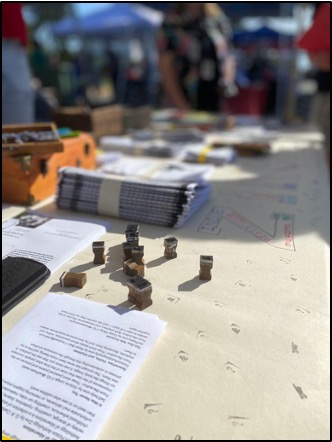
Students opt to write zines about any topic: political or personal; local or global; incredibly niche or typically mainstream. The length of the zine is also determined by each student, as is the size; the class produces a bevy of minizines, quarto, and folio folds.
For example, one zine created by Kelli in Fall 2021, was a 16-page quarto fold titled, This Person Does Not Exist. She combined her writing with physical art by creating black and white drawings of human faces that were digitally generated by a free AI tool. [6] Underneath each sketch, Kelli wrote two lines: one listing their profession (ex. “Best Buy employee”) and one listing a bizarre fact or habit (ex. “Collects her cats’ eyelashes to paint miniatures of U.S. presidents”). She also added unedited parts of the drafting stage in her zine, including comments naming each “person.” Noticing she had excess white spaces, Kelli added their names late in production which invited readers to see her thought process (Figure 2).
Imperfection was part of the aesthetic, achieved through the messy assemblage of repurposed text and photocopied images, and brought together with twine or haphazard staples. While students could also design their zines digitally using templates or software, cut-and-paste methods were often more attractive, as students embraced the hodgepodge.
Making do meant also attending to costs. Throughout the unit, students were conscious of the money they were spending on their publications: the cost of printing—especially evaluating what types of paper they were using and whether to print in color or black-and-white—was a financial constraint. Black-and-white was cheaper to print, but if a student wanted a degree of color, this led them to utilize another resource beyond printer ink, such as a colorful threaded binding (which they learned how to sew) or perhaps a color cardstock cover. In Kelli’s case, she noticed image noise on the scans of her zine. Over several attempts, she reduced the noise but could not remove it entirely. Eventually Kelli accepted the “messy” look because the goal of zine making was not to produce a polished final product, but to experiment and learn. Process-based grading, which included a reflective component important to projects like this, also encouraged Kelli to focus on the ups and downs that came with tinkering and the lessons that could be gleaned from failure without worrying about a “bad” final draft tanking her grade.
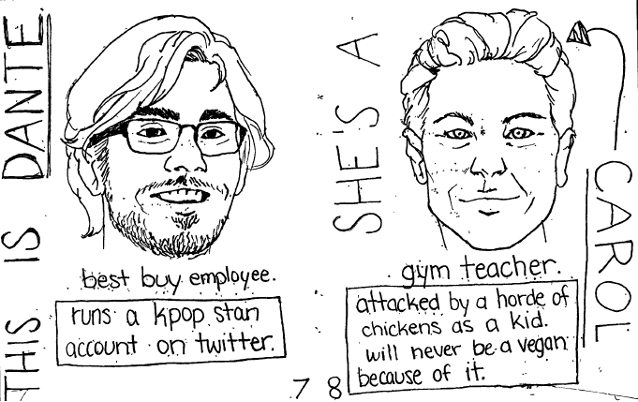
Figure 2. Excerpt from This Person Does Not Exist.
While zines are a helpful way of introducing students to making do and tinkering by way of publishing, this is not limited to physical encounters with materials. In another course, Introduction to Writing Arts, students spent one four-week unit focused on multimodal writing by creating a 90-second episode for The Phono Project, a podcast that explores the cultural histories of 78 rpm records, digitized via The Internet Archive’s Great 78 Project (for more about this curriculum see Luther in Stedman et al.).
For the first few weeks, students practiced creating WordPress sites and writing blog posts where they would first analyze podcast production and later review songs of their choosing. Without access to expensive recording equipment, students were shown options based on everyday technologies they already owned, including apps on their existing laptops or smartphones. For recording audio, for instance, students were encouraged to use the Voice Notes apps, or the built-in voice-recording software installed on their PCs. Manipulating audio was often done through Audacity—an open-source digital audio editor. The podcasts themselves would be hosted on a shared WordPress site, which was made easier to navigate since students had been maintaining their blogs throughout the module.
Analyzing and discussing podcasts and audio writing in the classroom gave students an understanding of what strategies may or may not work while writing and editing their own podcasts, and they were encouraged to experiment with format and audio manipulation while they produced drafts. For instance, Matt recalls recording his podcast script five to six times in different settings with his phone’s Voice Notes app before getting the ambience and cadence right. Through each new recording, he tweaked his inflection, his pacing, even rewriting parts of his script that flowed less naturally in speech. Editing in Audacity introduced even more opportunities for tinkering—long hours were spent experimenting with techniques Jason had taught the class while also revisiting other podcasts (be they Phono Project or otherwise) to keep an ear out for tricks Matt wanted to mimic for his own recording. The major challenge was making sure the recording did justice to its subject matter—standing as an engaging piece of media that was listenable.
In her articulation of a model for creative-critical tinkering, Danielle Koupf concludes that “[t]inkering proceeds by trial and error, making failure, or at least occasional setbacks, inevitable. Supporting tinkering requires lowering the stakes for assigned writing and introducing open-ended activities” (np). While we have found multimodal conditions for tinkering in our own classroom through zines and podcasts, Koupf reminds us that language itself can be experimented and played with especially if teachers can encourage resilience, deprioritize grading or formal assessment, and provide opportunities for play via activities such as scrap writing, blackout poetry, or cut-and-paste re-visioning. While LLMs can also offer other opportunities for play, from scenario-making to pantomiming voices, we have found such activities are not only fraught with ethical concerns but are not as meaningful when it comes to ownership—an essential precondition to self-publishing.
Emergence
In both examples—zines in Self-Publishing and podcasts in Intro to Writing Arts—classroom-based, curricular initiatives were used to provide students with practice making do and tinkering their way to a product that could be taken up by audiences, whether at a book festival or online. What’s important about these encounters is that over time, a collective scene emerges. Aside from its cancellation in 2020 due to the pandemic, students in Self-Publishing have tabled at the Collingswood Book Festival every year since their first in 2019; and while the Phono Project is on hiatus, it is still live on the web, having published nearly 200 student projects. Such emergence shapes its own definitions of success and failure via entanglements with strangers.
Knowing a book festival will be the culmination of the unit, students create zines with this stranger sociability in mind. That is, they eventually stand alongside—learning from but also competing with—other vendors who self-published their own fantasy novels, memoirs, and historical fiction. They learn how to anticipate readers who held no obligation to them or their writing in the ways that a peer or instructor might. With the goal of publishing being to establish a readership, hosting a booth at the Collingswood Book Festival gave students the opportunity to introduce themselves as writers beyond the Rowan campus. They were also responsible for pricing their zines and engaging with prospective readers who sometimes expressed interest, but more often just walked away. In this way, the experience was just as educational when unsuccessful: students had to manage rejection and indifference towards their writing in a pseudo-marketplace. Perhaps because of this, they supported and promoted each other’s zines as frequently as their own. Though their participation fluctuated, offering the opportunity for involvement—creating a zine “scene”—invited a sense of community.
And as engaging, listenable podcasts accumulated into hundreds of examples over the course of several semesters, The Phono Project also emerged into a recognizable publication. Once it did, the Internet Archive invited us to present at Public Domain Day in 2022, an annual event that celebrates works whose copyrights are expiring. And a year later, when corporate record labels began to file lawsuits against the Internet Archive for hosting 78 rpm records, founder Brewster Kahle cited The Phono Project as an important reason for fighting back (Belanger).
In many ways The Phono Project is the coalescence of amateur creators and preservationists, whose digital recordings made it possible for The Phono Project to exist in the first place. While students and the Archive operated as different entities, the conjoined effort of each group was what allowed the podcasts to rejuvenate these valuable pieces of cultural history. As a DIY ethic, emergence is often a measure of success.
While the annual book festival and The Phono Project offer examples of what can emerge when we develop opportunities for students to publish in our classes, programmatically and culturally, emergence is even more important outside of the classroom. To experience the multifaceted aspects of a publisher’s risks and failures, students need to inhabit multiple roles, including what it means to run a magazine or serve on an editing team, where they more authentically grapple with a publication’s gatekeeping function as it exists in relation to readership, marketplaces, and the attention of publics. This also requires shifting ownership from faculty to students—which itself can feel like a risky enterprise.
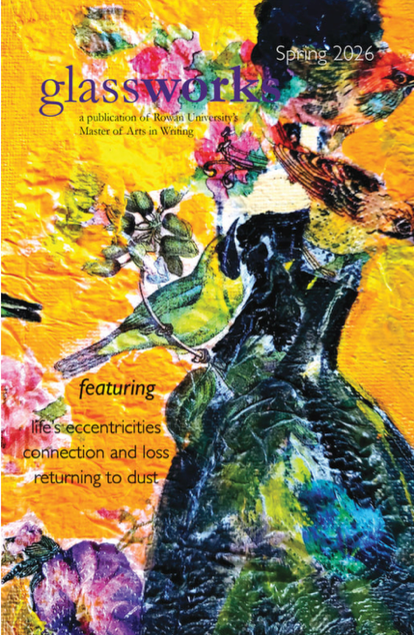
For instance, the editorial team of first several issues of the department’s literary magazine, Glassworks (founded in 2011, see Figure 3), were comprised mostly of faculty members. However, thanks to the encouragement of a dean, it eventually began selecting student interns like Gianna and Kelli to support their work, providing valuable editorial experience in the process. Today, over a decade later, two faculty members lead a mix of graduate and undergraduate students in publishing two issues each year. Some students come in with a fresh slate and no familiarity with Glassworks, while others have taken its associated graduate course, Editing the Literary Journal, each fall and participate as interns. [8]
The MA program is not large, and some semesters, there are only a handful of people available to read through hundreds of submissions, manage social media and marketing, and conduct editorial content including author interviews, op-eds, and book reviews. During both Editing the Literary Journal and the internship, students must read a minimum of ten submissions each week. Once enough pieces have been approved, a “packet meeting” is held, where submissions are reread by the entire group and voted on one last time. This experience puts students on the other side of an acceptance and rejection process, and often for the first time, providing a different relationship to the concept of failure. Sometimes, they learn that a rejection is entirely arbitrary; there are already too many poems about birds that have been accepted, more than half of the room disliked second-person narration, or the content was good, but the formatting was incompatible with the magazine. To witness the rejection of pieces that could have easily been one’s own demystifies the process of submitting to a literary magazine. For many, that experience alone can be enough to encourage taking a risk and submitting their own work.
This co-curricular model has been a fruitful one for Writing Arts. In 2019, Jason applied for and received an internal grant from Rowan’s Center for Innovation and Entrepreneurship to start a digital, student-run, pop culture magazine, complemented by the development of a new course called Writing About Popular Culture. Like the relationship between Editing the Literary Journal and Glassworks, the intention was to create a mutually reinforcing scene of activity, where students in the class would be encouraged to submit their writing assignments to the site, and the site in turn would help attract more students to the course and an internship.
In this way, emergence isn’t magic, and it often takes time and programmatic engineering for a publication to begin to develop. For example, while a handful of interns and volunteers began planning a vision in 2019–2020, arriving at the name Halftone, and making plans to attend the Pop Culture Association’s annual conference held in nearby Philadelphia that year, the COVID-19 pandemic stalled momentum, and magazine didn’t recover until 2021, once it was safe to return to campus. Once we did, four full-time interns, including Casey and Matt, devoted several hours per week to soft launching the website and developing editorial processes. Meetings were held weekly, loosely guided by Jason, who was upfront about his desire for the magazine to be student-led, encouraging interns to take charge of discussions and propose ideas. At first, this was disorienting. While students can feel stifled by an overly restrictive curriculum, building a viable prototype of a digital publication from scratch was daunting.
Meanwhile, in Spring 2022, the first iteration of Writing About Pop Culture opened for registration. As Halftone’s curricular complement, it was designed to introduce students to works by various critics across a multitude of modes and genres. The class has since been divided into three parts for the three genres that are often published—personal essay, review, and cultural analysis—with the idea that these genres would be most welcome at Halftone. Exigence is often a central focus of the class; not just what drives a person to write a piece because they are fans, but what drives an editor to publish a piece and person to read it—one piece, out of the millions of articles being published in a digital public sphere filled with updated hot takes on pop culture.
For a while, it was a struggle to reconcile the more entrepreneurial mindset with the mission statement of Halftone: to produce “work that pushes boundaries; work that provides a voice to the unheard or ignored.” The most exciting pieces—to write and to read—are those motivated by passion, but attention was also a rare and precious commodity, and we hardly knew the secrets of the algorithm. What is relevant one moment is quickly buried the next. Reshaping a piece to uncover that exigence has since become an important and essential part of being a Halftone editor. In the interest of guiding students through publishing literacies (and giving them work they can share with future employers), Halftone rarely rejects submissions. Editors are prepared to work with a writer through as many revisions as necessary, which vary from small and superficial edits to more substantial ones concerning content and structure.
However, once a student-managed publication like Glassworks or Halftone emerges, continuity can become both an affordance and a limitation. While interns sometimes stay on for multiple semesters, they often graduate or aren’t readily available when the next crop arrives. The documentation of each cohort’s successes and failures has therefore been critical in the development of Halftone. Editors and interns have not only learned how to temper their expectations, but also how to share their adjustments with the next generation. Students entering the internship gain access to a well-organized Google Drive that includes notes, instructions, and letters from previous interns. And by utilizing Discord—a messaging platform primarily built for gamers—interns use a dedicated server for Halftone to facilitate communication between editors, authors, and interested readers. This process of re-emergence is important for breathing new life into the publications and offering a slightly different sandbox for incoming editors, who often have to define and articulate what success and failure might look like during their tenure.
Creative Entrepreneurship
Whether measured by time, space, tools, or materials, an ongoing challenge for publishers is cost; while making do often helps compromise on some of these challenges, a DIY ethic means looking for ways to fund creativity while minimizing capitalist imperatives for competition and growth. Likewise, when teaching publishing as a literacy, it is necessary to find ways to engage students with a variety of business models—directly or indirectly—in sustainable ways. While certainly selling zines at a book festival provides some important experience with a literal marketplace, approximating a small (self-)publishing businesses model can do this more holistically.
In 2018, Associate Professor Megan Atwood recognized there was a growing need for such a model and received an internal grant to start Singularity Press. Managed by Professor Atwood and run by a mix of undergraduate and graduate students, Singularity Press is not really a “press” at all, at least not in the traditional sense that it publishes books; that is, it offers services for copy editing, layout and design, and marketing to hopeful authors and self-publishers. Clients are unaffiliated with Rowan University, and to date, Singularity Press has edited over ten manuscripts.
As with other co-curricular iterations in the Department, Professor Atwood established an undergraduate course component in fall of 2023—Editing the Book—as a special topics course. This had majors engaging more programmatically with Singularity Press as students in the class primarily created supporting content by writing blogs, recording podcasts, and managing Singularity’s social media.
An internship with Singularity Press is also available outside of the requirements of a course. Like Halftone, internships by their nature are different from a class and test students’ abilities to collaborate and take risks that could potentially spawn further growth, knowing there is a chance they may not pan out. Generally, there are no supervisors checking the work of an intern who is leaving comments on a client’s manuscript; however, there are a group of other students who will see and take note of chapters that may have been neglected or offer suggestions for areas that need rewording. Knowing there’s a team—and learning how to manage when that team cannot help—are necessary skills to work efficiently.
Students are therefore often met with an opportunity they may not have in a typical writing classroom, which is maintain the brand with some semblance of publicity. Gianna, who spent three semesters with Singularity, finds that having the experience she gained during her internship translated not just to her personal writing life, but to her full-time job. Managing the Wix site for Singularity, which often led to countless frustrated hours reading online forums about back-end problems and coding, proved to be useful; at her current job, multiple clients use Wix as their CMS. Perhaps more importantly, and like students who have used WordPress when running Halftone, Gianna gained confidence in her ability to understand other unfamiliar interfaces because she had done so before. Risk-taking can take many forms, and that includes the ability to choose to learn a new tool rather than give up before even trying. Self-sufficiency and autonomy are vital in publishing, and they are skills not everyone possesses without learning them first.
Conclusion
In this profile we have presented examples of how students have authorized their writing by drawing from four implicit—and sometimes explicit—practices fostered by a DIY ethos. While many of these projects were initially proposed by faculty members, through various means (a public event, multimodal assignment, and co-curricular grant), the projects still assembled a scene of publishing for students to step into so that they could make-do, tinker, innovate, and build as co-authors.
We conclude in punk fashion by mapping four “negations” onto these four practices, designed to guide faculty and students who are interested in adapting a DIY ethic within their own institutions.
First, making do does not mean faculty and students should only look inward and immediately for resources. It should not be taken as repackaged bootstrapping. It means being aware of one’s environment. Rather than trying to emulate work produced by those with more expansive resources (such as Harper Collins or Conde Nast), it innovates with what’s available. And sometimes what’s available requires compromise. As noted, Halftone and Singularity Press originated thanks to internal grants offered at Rowan University. That seed money not only paid for hosting and helped bring students to the literal table with pizza and other food, but sparked interest through paid internships. Put another way, faculty were able to fund these projects because of the entrepreneurial risks rewarded by the University—a school that changed its name thanks to a historic donation from Henry Rowan, an entrepreneur himself. While these, at times, positioned faculty and students in undesirable arrangements, they were sometimes worth the risk at creating something new.
Second, tinkering can help normalize failure, but this is hardly a natural process. Tinkerers often have to process what success looks like for themselves and how to respond when their process doesn’t lead them to it. Often this is facilitated via guided reflection, whether through an assignment in a classroom or a letter to future interns. While Kelli articulated her success with the zine assignment by doing more with less, Casey and Matt wrote about feeling disappointed with their zines. Casey created more of a book art object than a reproducible prototype (“a trinket than a treasure,” as they put it) while Matt’s creative ambition outpaced his abilities at the time. He endeavored to craft a short horror story in his zine, using scraps of old pulp fiction cover art to paint a campy atmosphere in between canned bits of writing. But the pictures at his disposal failed to build the atmosphere he was hoping for, and piecing together the images and the writing was much harder than he anticipated. Ultimately, Matt ended up with a little flipbook of skeletons and corny phrases in black-and-white printer paper.
DIY’s emphasis on emergence also means not restraining co-authors to certain projects over others, including faculty. Keeping an eye toward futurity involves looking for new possibilities for collaboration throughout a program, university, and community. These co-authored spaces ultimately are jumping-off points or invitations for a new scene or space to emerge. The Phono Project, for instance, grew out of the collaboration between the Internet Archive and professional preservationists, using their work to create a space of its own. Without the Great 78 Project, The Phono Project may not have had the resources necessary to form into its own body of work and space of collaboration. As is reflected in the collaborative process behind zine-making, and the community that grew around Halftone, piggybacking from existing creative work is not something to be afraid of, and in fact is essential for forming new avenues of creation and collaboration.
Finally, under a DIY ethos, entrepreneurial success is not defined by growth. For authors, this means accepting that publications have limited life cycles—and in some cases, they never actually reach a market. And, of course, each of these projects have endured some turbulence from COVID. We mentioned how the pandemic interrupted progress with Halftone, for instance, and in 2020 the Collingswood Book Festival was canceled. And because Introduction to Writing Arts is no longer offered in its previous form, The Phono Project has been on indefinite hiatus since Public Domain Day in early 2022. This does not mean that they are any less successful pedagogically than ongoing projects.
Taken together, we have four hopes for this profile: first, we hope scholars of risk and failure see the richness of DIY culture and its overarching ethics and consider it for future sites of study; second, we encourage composition teachers to continue to explore the richness of self-sponsored literacies within and beyond their classrooms; third, we hope programs looking to provide more opportunities for risk and failure throughout their program consider the affordances of publishing literacies. Relatedly, we believe there is much more to say on the rising challenges for publishing in the years to come, especially as generative AI and algorithmic digital marketing threaten not only students’ willingness to take risks, but to saturate and devalue writing writ large. We encourage our colleagues working in programs that push publishing to the fore to share their successes and failures with us moving forward.
Notes
[1] Each of which are also offered as minors and certificates of undergraduate study.
[2] For more on this era of the Writing Arts major see Courtney et al. and Tweedie et al. in Giberson and Moriarty (2010).
[3] Some of these include Whitman College’s Department of Rhetoric, Writing, and Public Discourse, Middle Tennessee State’s B.S. in Public Writing and Rhetoric, Hofstra University’s B.A. in Rhetoric and Public Advocacy, Regent University’s program in Rhetoric & Public Culture, and Purdue University’s Concentration in Communication Rhetoric and Public Advocacy.
[4] LLMs have provoked the field to question the nature of several key concepts, including the ethics of writing technologies, the relationship between thinking and writing, the definition of collaborative writing, and engaging with multimodal tools that go beyond the digital.
[5] See, for example, Anne Dalke’s exploration of her students’ attempts at running reading and writing groups in a Philadelphia-area prison in “A Force of Disruption: Refusing the Success/Failure Complex” from Failure Pedagogies.
[6] A note about methodology: this profile is hardly comprehensive. Not all courses in Writing Arts involve publishing and not all of them make use of a DIY ethos. And even while some might, they are arguably prefigured under different philosophies. While our sketch of Writing Arts is obviously limited by the experiences of the authors, we sought other perspectives by interviewing two other valued faculty members: Professors Katie Budris and Megan Atwood.
[7] It is important to note that at the time when Kelli used this tool in September 2021, consumer-facing chatbots like Chat-GPT were still more than a year away from being released to the public.
[8] Editing the Literary Journal is not a requirement to become an intern in the spring or summer, and not every intern has taken the course.
Works Cited
Beck, Estee. Discovering Maker Literacies: Tinkering with a Constructionist Approach and Maker Competencies. Computers and Composition, vol. 58, Dec. 2020, 102604.
Belanger, Ashley. Internet Archive’s Legal Woes Mount as Record Labels Sue for $400M. Ars Technica, 15 Aug. 2023, https://arstechnica.com/tech-policy/2023/08/record-labels-sue-internet-archive-for-digitizing-obsolete-vintage-records/.
Berman, Craighton. Crowdfunding for Designers [Zine]. Chicago, 2022.
brown, adrienne maree. Emergent Strategy: Shaping Change, Changing Worlds. AK Press, 2017.
Ceraso, Steph, et al. Learning as Coordination: Postpedagogy and Design. enculturation, 3 May 2019, https://designpedagogy.github.io/.
Courtney, Jennifer, et al. The Writing Arts Major: A Work in Process. What We Are Becoming: Developments in Undergraduate Writing Majors, edited by Greg Giberson and Thomas A. Moriarty, Utah State University Press, 2010, pp. 243–59.
Dalke, Anne. “A Force of Disruption: Refusing the Success/Failure Complex.” Failure Pedagogies: Learning and Unlearning What It Means to Fail, edited by Allison D. Carr and Laura R. Micciche, Peter Lang, 2020, pp. 99–116.
Eichhorn, Kate. Adjusted Margin: Xerography, Art, and Activism in the Late Twentieth Century. The MIT Press, 2016.
Farmer, Frank. After the Public Turn: Composition, Counterpublics, and the Citizen Bricoleur. Utah State University Press, 2013.
Gruwell, Leigh. Making Matters: Craft, Ethics, and New Materialist Rhetorics. Utah State University Press, 2022.
Kohtala, Cindy, et al. Introduction: Alternative Histories in DIY Cultures and Maker Utopias. Digital Culture & Society, vol. 6, no. 1, Dec. 2020, pp. 5–34. https://doi.org/10.14361/dcs-2020-0102.
Koupf, Danielle. Proliferating Textual Possibilities: Toward Pedagogies of Critical-Creative Tinkering. Composition Forum, vol. 35, 2017, https://compositionforum.com/issue/35/proliferating.php.
Laquintano, Timothy. Mass Authorship and the Rise of Self-Publishing. University of Iowa Press, 2016.
Luther, Jason, Kristin Prins, and Frank Farmer. Making the Scene: The Rhetoric of DIY Composition. enculturation, 26 Apr. 2023, https://enculturation.net/diy_composition.
Luther, Jason. From Cylinders to WordPress: Using Digital Sound Archives for Short-Form Radio Programs. Amplifying Soundwriting: Theory and Practice in Rhetoric and Writing, edited by Kyle Stedman, Courtney S. Danforth, and Michael J. Farris, The WAC Clearinghouse, 2022, pp. 185–195.
Luvaas, Brent Adam. DIY Style: Fashion, Music and Global Digital Cultures. Berg, 2012.
Marche, Stephen. On Writing and Failure. Biblioasis, 2023.
Spencer, Amy. DIY: The Rise of Lo-Fi Culture. Marion Boyars Publishers, 2005.
Shivers-McNair, Ann. Beyond the Makerspace: Making and Relational Rhetorics. University of Michigan Press, 2021.
Teagarden, Alexis, Justin Mando, and Carolyn Commer. “Counterpoint: Why Not Intellectual Risk?” If at First You Don’t Succeed? Writing, Rhetoric, and the Question of Failure, edited by Steven J. Corbett, The WAC Clearinghouse; University Press of Colorado, 2024, pp. 47–64. https://doi.org/10.37514/PER-B.2024.2494.2.02.
Teagarden, Alexis, Carolyn Commer, Ana Cooke, and Justin Mando. Intellectual Risk in the Writing Classroom: Navigating Tensions in Educational Values and Classroom Practice. Composition Studies, vol. 46, no. 2, Fall 2018, pp. 116–136.
Tweedie, Sanford, et al. What Exactly Is This Major?: Creating Disciplinary Identity through an Introductory Course. What We Are Becoming: Developments in Undergraduate Writing Majors, edited by Greg Giberson and Thomas A. Moriarty, Utah State University Press, 2010, pp. 260–76.